
Your next reputational crisis may not begin with a careless employee, an angry customer, or a negative headline. It may begin with an AI agent that was given access to your business but was never properly onboarded, supervised, or taught where its authority ends.
AI is rapidly moving beyond the role of a tool that waits for instructions. New systems can analyze information, plan a sequence of actions, contact customers, qualify leads, schedule meetings, and make operational decisions with limited human involvement.
In practical terms, companies are beginning to manage AI usage as part of the workforce.
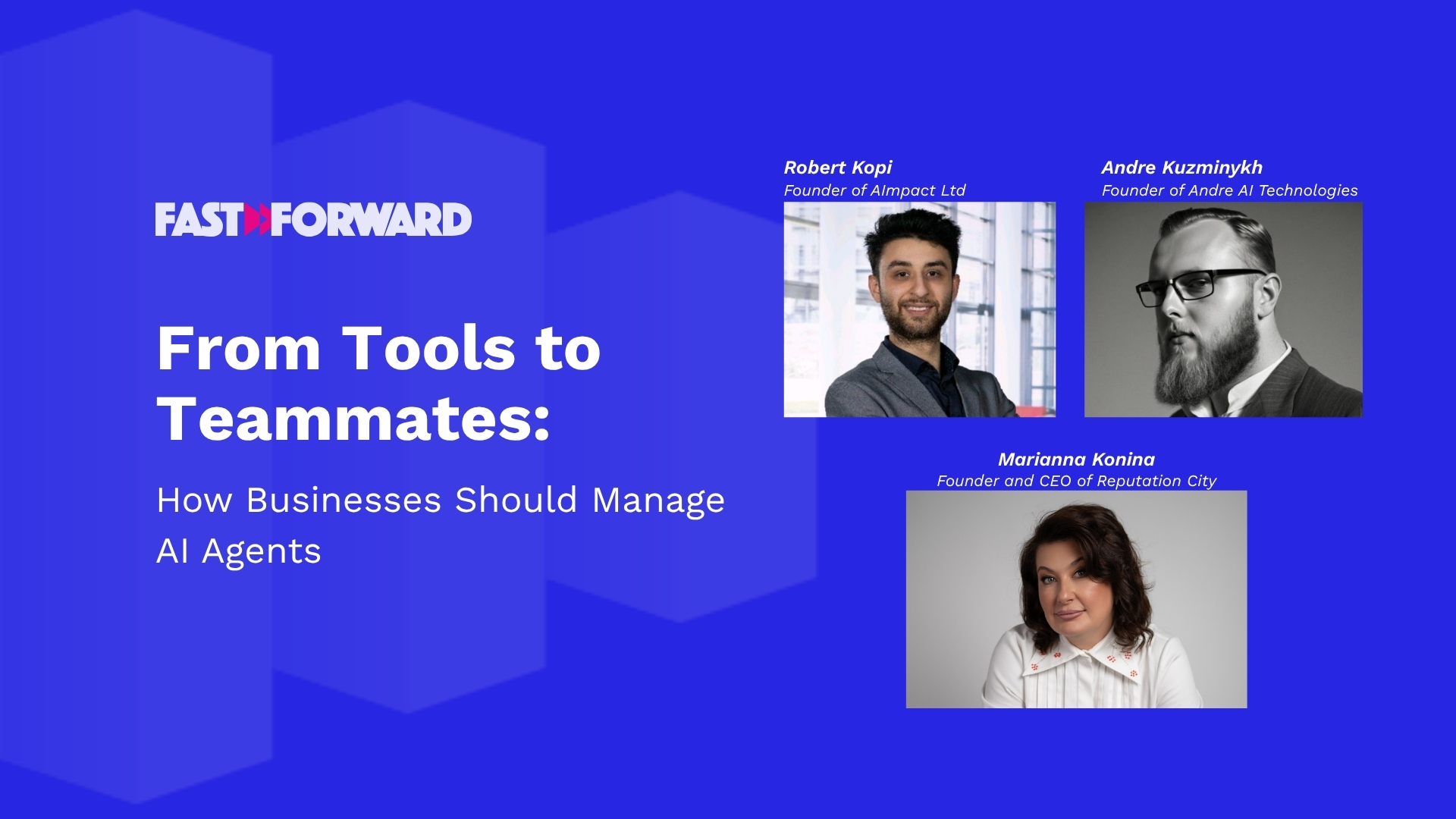
In her latest article for Fast Forward Magazine, Marianna Konina, Founder and CEO of Reputation City, explores this shift through the ideas presented at AI Expo Cyprus. The discussion focused on a question that is becoming increasingly important for business leaders: what happens when AI stops behaving like software and starts operating like a colleague?
AI Agents Need More Than Technical Access
Companies usually approach AI adoption as a technology project. They choose a platform, connect data, automate several processes, and expect efficiency to follow.
But an AI agent that can act independently is not simply another piece of software. It performs tasks on behalf of the company, interacts with people, handles information, and may influence how customers, employees, and partners perceive the organization.
That means the real challenge is integration.
Research cited in the original Fast Forward article found that 46% of newly hired employees fail within their first 18 months. Only a small proportion of those failures are caused by insufficient technical ability. More often, the problem lies in motivation, coachability, emotional intelligence, or cultural compatibility.
AI does not have emotions or personal ambitions, but the underlying organizational problem remains surprisingly similar. A capable system can still fail when it does not understand its role, lacks sufficient context, operates without clear boundaries, or receives no meaningful supervision.
The difference is that a human employee may make several mistakes during a working day. An AI agent can reproduce the same mistake hundreds or thousands of times before anyone notices.
The Difference Between Automation and an AI Workforce

At AI Expo Cyprus, entrepreneur and Founder of AImpact Ltd, Robert Kopi described the arrival of what he called the “Agentive Age.”
Traditional generative AI is largely reactive. A person submits a request, and the system produces an answer. Agentic AI can go further: it evaluates a situation, creates a plan, performs actions, reviews the outcome, and continues working through the process.
This expands more than output. It increases operational capacity.
However, greater autonomy also creates greater responsibility. If an AI agent communicates inaccurate information, mishandles a customer, makes an inappropriate recommendation, or uses sensitive data incorrectly, the public will not separate the system from the company that deployed it.
The reputational responsibility remains human.
Two examples illustrate why governance matters. McDonald’s discontinued its AI drive-through trial after ordering errors became widely shared online. IBM’s AskHR chatbot, by contrast, has successfully resolved the majority of routine HR requests while directing more complex cases to people.
The difference was not simply which company had access to better technology. It was how each system was placed inside an operational structure and whether mechanisms existed to identify and correct mistakes before they affected users.
Human Oversight Does Not Defeat the Purpose of AI
Some businesses assume that involving people in an automated process reduces its value, but in reality, human oversight is often what makes safe scaling possible.
Robert Kopi proposed a model in which AI processes large volumes of work while people retain control over specific decision points. Actions can be reviewed, audit trails remain available, and sensitive cases can be escalated.
This approach was demonstrated through the example of Domenica Group. The company had accumulated thousands of inactive sales leads that would have required too much human time to revisit manually.
An AI agent analyzed those leads, planned the outreach, made calls, qualified potential clients, and added meetings directly to the sales team’s calendar. Within 30 days, the system generated 50 new appointments and additional revenue without new advertising expenditure or human calls.
The success came from assigning it a specific role, providing an appropriate process, and establishing control around its activity, not from giving AI unrestricted freedom.
For businesses, this distinction is critical. The strongest competitive advantage may no longer be access to AI itself, because similar technology is becoming available to everyone. The real advantage will be the ability to deploy it consistently, responsibly, and at scale.
From AI-Driven to AI-Native Business

Andre Kuzminykh, Founder of Andre AI Technologies, presented a broader view of how organizations are evolving around AI.
An AI-driven company uses intelligent assistants to accelerate existing tasks while people continue to make the main decisions. An AI-first company builds its operating model around agents, with people designing and supervising the system. An AI-native company goes even further: AI becomes part of the product itself.
This transition requires more than purchasing new tools. Kuzminykh’s maturity framework considers governance, organizational culture, infrastructure, data, models, engineering, and research and development.
It also changes human roles rather than simply removing them. Some employees will translate business processes into AI workflows. Others will operate and monitor groups of agents. Founders may eventually manage networks of AI systems capable of performing work that previously required much larger teams.
This could make the “solo founder” model significantly more powerful. One person may be able to direct ten or more AI agents without increasing the human workforce at the same rate.
Yet a company cannot become AI-first if its employees do not trust the transformation. The Fast Forward article also highlights that 31% of employees may actively resist or undermine AI when they perceive it as surveillance or a threat to their jobs.
Ignoring that resistance is dangerous. AI adoption is also an internal communication and change-management challenge. Employees need to understand why a system is being introduced, what decisions it can make, what data it can access, and how their own responsibilities will change.
An AI Agent Must Understand the Company It Represents
Even the most advanced AI agent can fail when it lacks organizational context.
Companies depend on informal relationships, changing priorities, internal knowledge, sensitive histories, and unwritten rules. An AI system designed only to process structured information may miss the context that helps a human employee understand what is appropriate in a particular situation.
Giving an agent deeper access may improve its performance, but it also introduces additional risk. The more the system knows about customers, employees, internal processes, and strategic decisions, the more carefully its permissions and outputs must be governed.
This creates a difficult balance: an AI agent needs enough context to act intelligently but not unlimited access that could expose the organization to privacy, security, compliance, or reputational consequences.
Before deploying such a system, companies should be able to answer several fundamental questions:
- What exactly is this agent responsible for?
- Which decisions may it make independently?
- When must a human approve or review its actions?
- What company and customer data can it access?
- How will mistakes be detected and corrected?
- Who is ultimately accountable for its output?
If these questions have no clear answers, the organization is not hiring an AI teammate. It is introducing an unmanaged risk.
Reputation Must Be Built Into AI Adoption
For Reputation City, this topic matters because every action performed by an AI agent can become part of a company’s public identity.
Customers may not know which model produced a response or which automation handled their request. They will remember whether the company was accurate, respectful, transparent, and reliable.
Poorly managed AI can create false claims, inconsistent communication, privacy concerns, customer frustration, and internal distrust. Well-managed AI can improve responsiveness, restore neglected opportunities, and make services more consistent.
The technology may be new, but the reputational principle is familiar:
trust depends on clear responsibility, predictable behavior, and the ability to correct mistakes.
Companies achieving meaningful results with AI are not necessarily those using the most powerful models. They are the ones defining roles carefully, establishing human decision points, preparing their teams, and treating governance as part of implementation rather than an afterthought.
AI agents may become some of the most productive members of the future workforce. But productivity alone does not make someone, or something, a good teammate.
The businesses that benefit will be those that learn how to hire AI carefully, manage it responsibly, and protect trust at every stage.
Read Marianna Konina’s full article in Fast Forward Magazine.
To explore how AI can bring order to complex operations, read our related article: AI’s Most Valuable Role Is Turning Business Chaos Into Structure
Have a questions? Let's get in touch
→ Contact us: hi@reputation.city